By Linda Carlisle
•
August 21, 2026
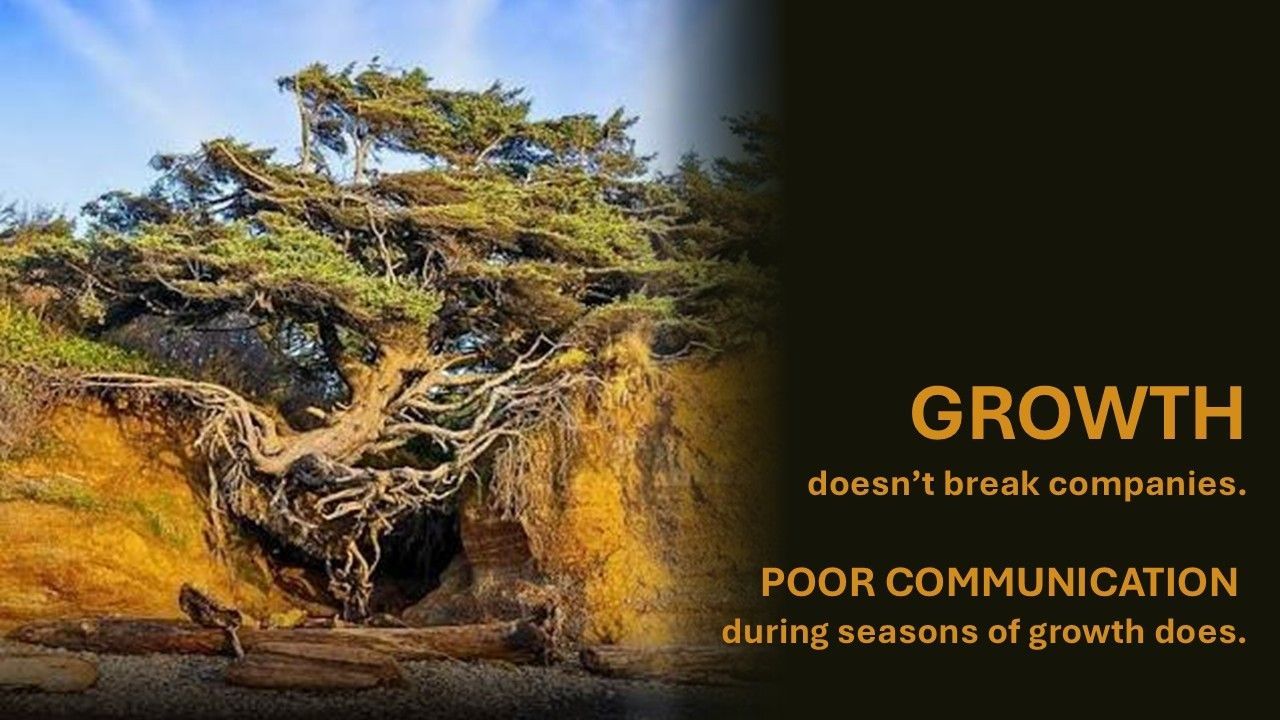
When a company appears on a “Fastest-growing” list, most people see success. I see a series of leadership moments quietly approaching. Don’t get me wrong -- rapid growth is wonderful. It means customers are buying. New people are joining your ranks. Opportunities are expanding. It means your organization is doing something right. But accelerated growth changes far more than the size of the organization. Everything from your leadership practices and communication habits to the cultural norms that helped a company succeed at 50 or 100 employees doesn’t necessarily work when you need to reach 300, 500, or 1,000 people. Yet companies often invest heavily in preparing the business for its next stage of growth – bringing in new systems, facilities, technology, financing… and even talent, while investing far less in preparing for how they will help their people navigate the changes that growth brings with them. And that's where success can unexpectedly create risk. When I think about the companies that do this right, I think of the giant redwoods. Redwoods can grow more than 90 meters tall, yet their root systems are surprisingly shallow. Rather than growing deep, their roots spread widely and intertwine with those of neighboring trees, helping these enormous trees support one another. And beneath the forest floor, those roots connect with networks of mycorrhizal fungi that enable the exchange of nutrients and information across the forest. Growing organizations need their own version of that interconnected system. As companies become larger and more complex, they need strong, adaptive communication systems and cultures that allow information to travel, people to remain connected, and the organization to respond collectively to change. The taller the organization grows, the more intentional those connections need to become. The Founder Can't Know Everyone Anymore In smaller organizations with 2 to 50 or 100 people, communication often happens through relationships built by proximity and ‘management by walking around’ (MWA). You’ve undoubtedly seen it. The founder walks through the building, stopping to greet individual employees by name. People hear what’s happening because they sit near someone who has the inside scoop. New employees learn about the culture by observing the people on their team. In the startup and early growth stages, there may not be much of a formal communication infrastructure in the business, because the company doesn’t need one. Then the company grows. Suddenly, the founder can’t talk to everyone. In addition to the greater demands that face the leader of a high-growth company, there may also be multiple locations, functions or shifts. New employees may never even meet the people who established the company’s earliest traditions. Decisions move through several layers of leadership before reaching the people expected to execute them. Consider a 75-person manufacturer that grows to 300 employees and opens a second facility. Employees at the original plant still hear news directly from leaders they know, while employees at the new location depend on supervisors and word of mouth. Without intending to, the company has created two very different communication experiences. The organization has crossed an important threshold: It can no longer rely primarily on relationships to keep people connected. It needs systems. Establishing and implementing communication systems and protocols, and documenting cultural norms, doesn’t mean replacing human connection with corporate bureaucracy. It simply means intentionally creating communication channels, leadership practices, and cultural mechanisms that allow information to keep flowing, transparency and inclusion to continue, and critical connections to survive as the organization becomes more complex. The Middle Management Gap Growth also creates another challenge: more managers -- many of whom are promoted because they were exceptional individual contributors. They know the business, understand the customers – and they get results. But suddenly, their job isn't simply to perform the work. As managers, they’re expected to explain strategy and translate leadership decisions into meaningful guidance for their functional team. Whereas they were once accountable for doing their own work exceptionally well, they are now expected to coach other employees and help them succeed – both professionally and inter-personally. They are now responsible for helping their teams navigate uncertainty, interpret cultural norms, and handle difficult conversations. In other words, they become one of the organization’s most important communication channels. Yet few companies intentionally prepare them for that role…and this is where communication often begins to fracture. Managers are also expected to answer questions they may never have anticipated being asked -- sometimes questions leadership hasn’t fully answered for them. Without talking points, FAQs, or a clear feedback loop for unanswered questions, managers are left to punt, avoid the question, or offer their “best guess.” That’s how inconsistent messages -- and rumors -- begin. Imagine a company where the CEO has just announced a new growth strategy at the town hall and assume managers will carry the message forward to their teams. Despite there being no detailed talking points, FAQ documents, or other tools to explain how the strategy will impact each individual business function, one manager soldiers through to explain what it means for the team; another forwards the slides the CEO used in the town hall; a third admits, “I’m not really sure what this means for us.” One announcement has suddenly become three different employee experiences. Senior leaders believe they’ve communicated something because they announced it. Managers interpret it differently. Employees hear different versions depending on which manager they report to. And a message that seemed perfectly clear in the executive meeting becomes increasingly distorted as it travels through the organization. In the absence of communications infrastructure (email, newsletter, intranet, Slack/Teams, regular town halls, etc.), growth makes effective manager communication capability a business requirement. Manager cascade is essential -- but consistently excellent manager cascade is also notoriously difficult to achieve without dedicated support focused on developing communications tools that enable managers to be effective and stay aligned as they announce strategic initiatives. Culture Stops Happening Naturally Culture changes as organizations scale. At 50 employees, culture spreads largely through proximity. People watch how the founder behaves. They learn which behaviors get rewarded. Stories travel quickly. Informal norms are reinforced every day. But at 400 employees, culture can’t depend on proximity. It must spread deliberately, by design. Leaders must become much more deliberate about defining the behaviors that matter to the company’s future success and describing what those behaviors look like in practice. Then they must reinforce them through managers, employee experience, communications, leadership modeling, and recognition. Otherwise, something else happens: Every department, location, or leader begins creating its own version of the culture. That’s how organizations wake up one day and realize the company they built no longer feels like the company they remember. Imagine a company that has doubled its workforce in 18 months, and added a 2nd shift. Half the employees learned “how we do things here” by working alongside the founders and early leaders; the other half joined after that proximity disappeared. Unless the culture has been made explicit, those two groups may be working from very different definitions of what the company values. Culture didn’t disappear. It drifted and decentralized. That’s why I often talk about building Culture by Design...Not by Default. Growth doesn’t make culture less important, but it does make leaving culture to chance much riskier. Today's Growth Often Creates Tomorrow's Moment That Matters™ Fast-growing companies also frequently sustain their momentum through other major transitions. • Private equity investment. • An acquisition. • International expansion. • A new facility. • Founder retirement. • Second-generation leadership. • An outside CEO. • A significant technology implementation. None of these transitions indicate that something has gone wrong…Quite the opposite. In fact, they often occur precisely because the company has been successful. But each one introduces another layer of organizational complexity -- and another test of whether the company’s leadership, communication, and culture infrastructure have grown alongside the business. The best time to focus on building these capabilities isn’t after the next major transition has already begun. It's before you need them. Consider a company receiving a significant capital infusion to acquire a competitor, build a new facility or dramatically expand production. The financial investment may solve the capacity problem, but it doesn't automatically create leadership alignment, strong communications discipline and practices, manager readiness, employee engagement or a unified culture. Those capabilities have to be built, too. And sophisticated growth planning should anticipate those needs before the capital is deployed…not discover them after execution begins. When Communication Becomes a Strategic Capability Eventually, growing organizations reach a point where communication can no longer be something “the leaders do” by walking around and chatting with people, or having more an more meetings. As organizations grow, “we all communicate” is no longer a communications strategy. The organization needs a disciplined approach for understanding what people need to know, which initiatives require coordinated communication, who needs to hear what and when, and which channels and messengers are best suited to the audience and the moment. • Leadership alignment before major announcements. • Manager toolkits that help supervisors translate strategy for their teams. • Internal communication channels that reliably reach employees across locations and functions. • Listening mechanisms that help leaders understand what employees are experiencing. • More intentional onboarding. • A stronger employer brand. • Greater executive visibility. • Clearer connections between business strategy and employees’ everyday work. These communications capabilities are not critical because communication suddenly becomes important. They become more essential as the organization becomes more complex. Because complexity creates distance. Distance between leaders and employees. Between strategy and execution. Between the culture leadership believes exists and the culture employees experience. A company can open its new facility on schedule and still struggle operationally if employees don’t understand why the company is expanding, what the change means for them, how the two locations will work together, or which cultural norms must remain consistent. The building may be ready for business before the organization is ready to operate as one company. And strategic organizational communication capabilities close these gaps in understanding. Growth Itself Is a Moment That Matters™ We tend to think about organizational communication challenges when something dramatic happens -- a merger, restructuring, new technology or strategy, a CEO transition, or another major transformation. And yes, any organization that undergoes these major milestones without addressing gaps in its professional communication capabilities is likely to struggle. But even with that said, some of the most consequential Moments that Matter™ arrive much more quietly, and they can outgrow your organization’s existing communication capabilities and cultural infrastructure without anyone immediately recognizing what’s happening. Consider the following everyday occurrences that quietly break the company’s ability to communicate effectively: • The company adds another 100 employees. • A second location opens. • The founder can’t attend every meeting anymore. • Another layer of management appears. • People who once knew one another personally now recognize only a fraction of their colleagues. In each of these situations, nothing is wrong. In fact, the company is winning. But success itself has fundamentally changed the organization. Fast growth deserves to be celebrated. But leaders shouldn’t wait until the next major transition to strengthen the culture and communication systems that will help their organizations scale. Because companies rarely stumble simply because demand exceeded capacity and the company needed to grow. They stumble when their leadership practices, communication systems, and culture don't evolve as quickly as the business does. If leadership says, “Give us the capital and resources we need, and we’ll grow” -- and someone provides them -- leadership then has an obligation to ensure the organization can convert those resources into performance. When a business struggles after receiving the capital, equipment, technology or acquisition it said it needed to reach the next level, stakeholders are justified in asking whether leadership adequately prepared the organization to capitalize on that investment. If the resources are there but the organization still can’t execute because people aren’t aligned, managers aren’t prepared, cultures aren’t integrating, or employees aren’t engaged, the problem may no longer be resources. It may be organizational readiness. And for a PE investor, board, or other stakeholder, that’s when a communication and culture problem can begin to look like a leadership problem. So yes, prepare the business for growth. Invest in the facility, technology, acquisition, and talent that will take the company to the next level. But invest in the communication and culture infrastructure that will help your people take it there, too. Like the redwoods, extraordinary growth requires an equally strong system of connection and support. The time to build that infrastructure isn't after growth exposes the gaps. It's before. Is your firm growing faster than its communication & culture infrastructure? If growth, expansion, acquisition or another major transition is on your horizon, I’d be happy to compare notes on what your organization may need before the gaps begin to show.